
2022q2
Regional eXplorer (ReX) update – 1st quarter of 2022
IHS Markit is glad to announce the fourth quarter update for 2022 of Regional eXplorer (ReX) – the South African knowledge base of municipal level insight. Each quarter, data from a vast number of sources are incorporated into the ReX database to provide users with the most up-to-date statistics.
- South Africa's real GDP recovers to pre-Covid-19 levels
- South African Macroeconomic outlook
- Main data release incorporated in this update
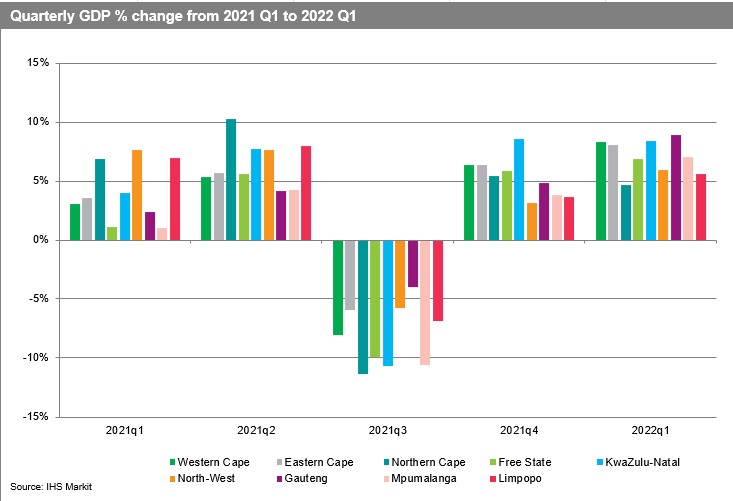
South Africa's real GDP recovers to pre-COVID-19 levels
In the first quarter of 2021 we saw that South Africa's GDP rose above figures from pre-coronavirus 2019 levels. However, it is predicted that the 2022 quarter 2 GDP figures will be under pressure as a result of the continued electricity supply disruptions, the economic impact of the floods in KwaZulu-Natal and China's COVID-19 lockdown measures.
- The GDP grew by 1.9% quarter on quarter during the 2022 quarter one which was above market expectations. The manufacturing sector was the largest contributor to the GDP followed by the trade sector.
- Both mining and construction sectors reported a slow down in their quarter on quarter contributions to South Africa's first quarter GDP.
- There was a quarter on quarter rebound of 2.1% for gross domestic expenditure during quarter one. This indicates a rising demand for machinery and equipment and transport equipment.
- In the first quarter, the net trade contribution to overall GDP remained negative as imports of goods and services grew by 4.9% q/q, compared with an increase in exports of goods and services of 3.9% q/q
Outlook
The above expectation GDP for quarter 1 in South Africa will likely increase the overall GDP growth in 2020, this is above IHS Markit's current estimate of 1.7%. An upward revision is expected for fixed investment spending and exports of goods and services. However, the growth prospects for rest of the year remain fragile due to disruptions of trade flows in KwaZulu-Natal after floods in April, increased electricity supply disruptions and lockdown measures enforced in Mainland China after COVID-19 outbreaks, leaving global commodity prices and demand less resilient. Furthermore, interest rates will continually be pushed up by an estimated 50-75 basis points in the latter half of 2022. However, support for South African households will come in the form of the extension of the COVID-19 Social Relief of Distress grant for the unemployed and the build-up of household savings during 2020–21.
South African Macroeconomic Outlook
Slowdown in export volumes from South Africa to the rest of the world is likely for the second half of 2022 due to global demand slowing amid tighter monetary policies within developed economies. Moreover, high global food and oil prices combined with investment-related imported good will increase South Africa's import bill, leading to the current account surplus likely to shrink in 2022.
South African Reserve Bank (SARB) increased their policy rate. After starting an interest rate normalization cycle in November 2020, the repo rate was increased by 25 points in March and a further 50 points in May. Additionally, the headline inflation is likely to average at 6.2% in 2022 which exceeds the inflation target range of the second quarter of 2022. The South African Reserve Bank (SARB) is likely to hike the rate by a further 25 basis points in July and September 2022.
Tighter monetary policy stance combined with higher inflation will slow households’ real disposable income growth during 2022. The household income and cost pressures in the economy will be cushioned by larger household savings after the second consecutive yearly rise in real savings- to- disposable income during 2021 combined with the extension of the special COVID-19 Social Relief of Distress grant for the unemployed. Nonetheless, spending will remain restricted by a 34.5% unemployment rate in South Africa.
Government revenue windfall will leave fiscal finances in a stronger position during 2021/22. During May and June 2022 the rand exchange rate came under renewed pressure after months of resilience. The tightening in global financial market conditions; a softening in global commodity prices, excluding oil and gas following the slowdown in mainland Chinese economic activity; and severe electricity disruptions in the South Africa economy contributed to rand weakness but the rand is likely to recover some of its losses during the latter half of 2022. Additionally, South Africa's current account should remain in a surplus position during 2022 and find support from higher interest rate and narrowing inflation differential.
Upside risks to South Africa’s near-term economic outlook. A landmark government announcement that lifts the licensing threshold for small-scale power generation projects from 1 megawatt (MW) to 100 MW could unlock private investment in the renewable energy segment of the economy from 2023 onward and should attract investor interest from mines, motor vehicle assembly lines, and the health sector. Although, project implementation could be fast-tracked to 2022, lifting private-sector investment beyond current estimates. The public-sector investment project pipeline has also been building, but project financing remains uncertain. Structural impediments, such as the loss in service delivery in larger metros, insufficient electricity and water supply, combined with rising financing cost, will continue to be a drag on the investment recovery in the South African economy.
Risks and Alternative Scenarios
Downside risks in South Africa remain prevalent in the short terms as social unrest continues to flare-up and disrupt business operations. The possible downside risks consist of the South African government delays government spending rationalization programs, which include the public-sector wage bill and state-owned enterprise (SOE) inefficiencies , Populist” policies such as land redistribution disrupt the agricultural production supply chain and jeopardize property rights in the South African economy. Ongoing adverse weather conditions pose an additional threat to low food prices, hence risks raising inflation and lowering purchasing power—with particularly dismal consequences for low-income households and the impact of rising bond yields in the developed world results in a sharp swing in portfolio flows out of emerging markets, including South Africa, resulting in higher inflation and interest rate than the baseline assumption. However there are some upside risk such as the South African government may launch a series of reforms and policy actions to address the weaknesses in the education system, loss in international competitiveness, the mining charter, and the financial viability and leadership of SOEs. Additionally, International commodity prices move above the baseline outlook; this improves the growth and exchange rate outlook in the South African economy and the South African government is partially successful in attaining USD100 billion in local and foreign investments within the next five years.
Main data release incorporated in this update
ReX has been updated with the latest data available from StatsSA, SARB, SARS and many more that allowed us to further update 2021 data on a sub-national level for most modules in ReX.
The Quarterly Labour Force Survey and recent GDP figures have been incorporated in the model. Community Services still remains the largest contributing sector to the national GDP however, this varies on provincial level, Both North- West, Northern Cape and Limpopo's highest contributing sector is the Mining whereas the Finance sector is the highest contributing sector for both Gauteng and Western Cape. The remaining four provinces highest contributing sector is the same as at national level.
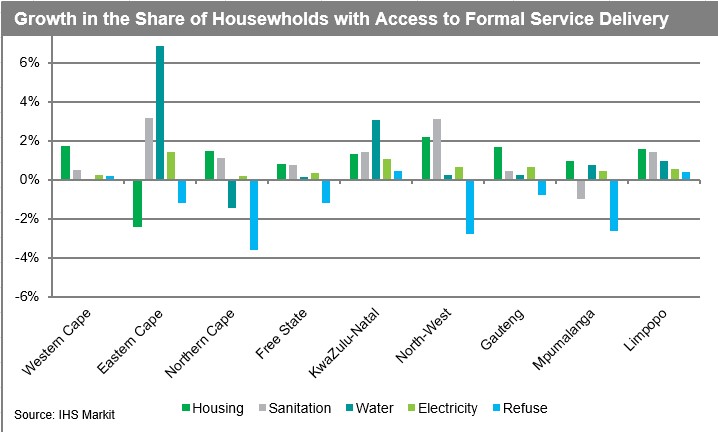
In the previous release Household Infrastructure was updated using new proxies however, the General Household Survey for 2021 has been released. Thus variables that are heavily dependent on the survey have been adjusted to include the latest information available for 2021. Based on the data within ReX, it is noted that in general, most provinces experienced an increase in service delivery of Housing, Sanitation, Water, and Electricity. However, almost every province saw a decrease in the number of households that have access to formal refuse removal. Furthermore, Eastern Cape saw a major growth in the share of households that have access to piped water at or above RDP-levels.
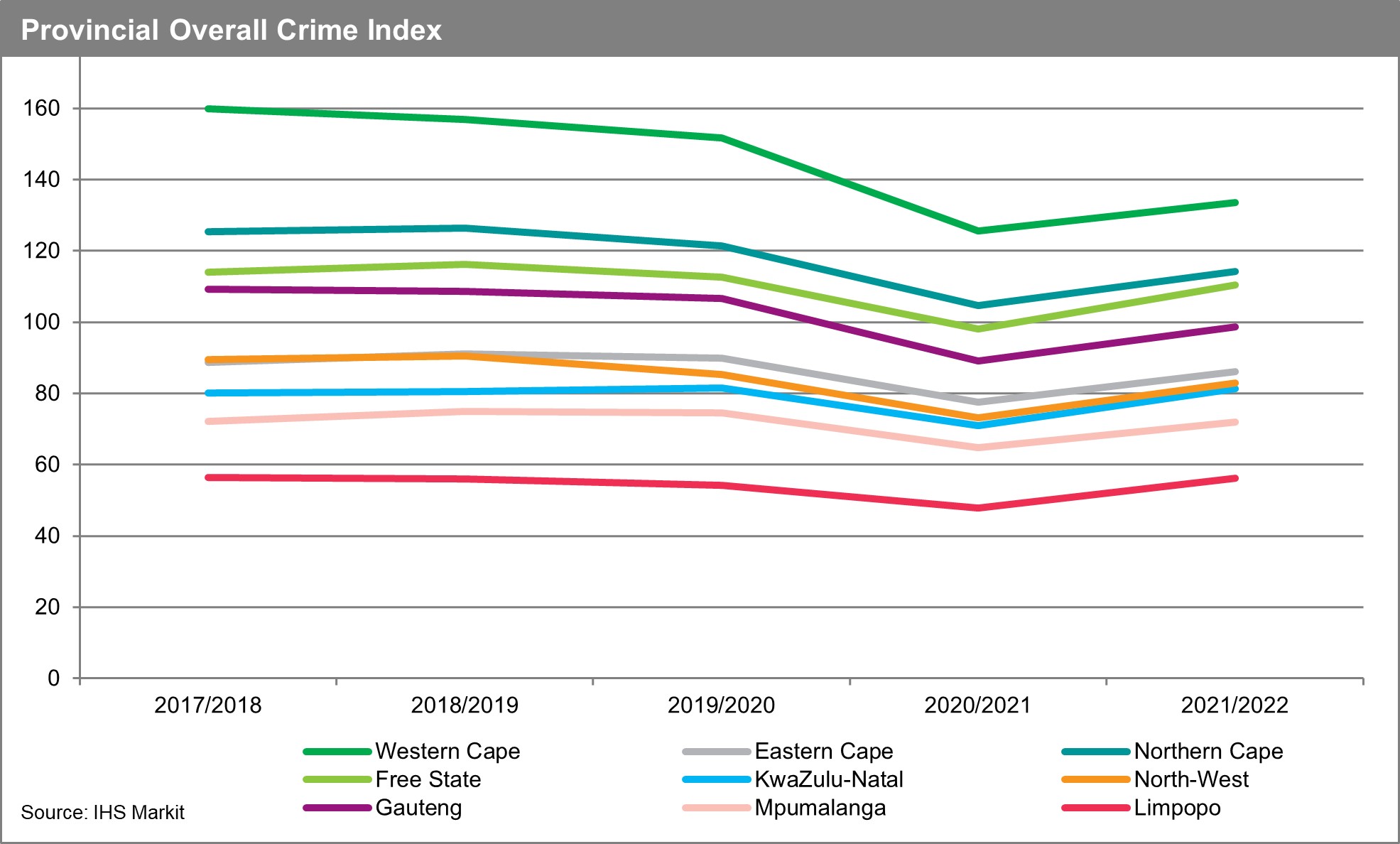
Additionally, the Crime Module has been updated to now include the latest 2021-22 data! The data is aggregated to annual numbers based off the SAPS quarterly statistics. Overall, the nine provinces follow a similar trend for the last five financial years. There was an increase in the Overall Crime Index in the 2021-22 years, this increase comes after the drop in the crime that was experienced in 2020 during lockdown.
`
The Fiscal Module should be updated in 2022q3 ReX release as the P9114 publication will only be released by StatsSA in late July.

Enjoy the update!
The IHS Markit ReX team