
2025q3
Regional eXplorer (ReX) update – 3rd quarter of 2025
S&P Global is glad to announce the third quarter update for 2025 of Regional eXplorer (ReX) – the South African knowledge base of municipal-level insight. Each quarter, data from a vast number of sources are incorporated into the ReX database to provide users with the most up-to-date statistics.
In this newsletter:
2. Adjusted US Tariff rates: Implications for African economies
3. Medium-and long-term outlook
1. S&P Global Market Intelligence has raised South Africa’s real GDP growth forecast to 1.2% for 2025 from 1%.
S&P Global Market Intelligence has raised South Africa’s 2025 real GDP growth forecast to 1.2% from 1%. A 0.8% quarter-over-quarter recovery in the second quarter exceeded expectations, primarily driven by household spending, which contributed 0.6 percentage point to growth. Additionally, inventory accumulation and positive government spending bolstered growth momentum. US exports represent nearly 5%-8% of South Africa’s total goods exports. The exports of automotive vehicles and parts, along with citrus fruits, will be the most affected by the increased tariffs imposed by the US. Precious metals —the biggest component of South Africa exports to the US — are exempted from the higher tariffs.
Rerouting US exports – to alternative markets in Asia could face obstacles. In June, mainland China eliminated all import tariffs for African countries under the WTO enabling clause. The new tariff structure is, however, formalized through the “China-Africa Economic Partnership for Shared Development,” which still needs to be signed by South Africa. Consequently, South African agricultural exports to China may struggle to compete with Australian and Chilean products. Although the direct impact of the US tariffs on South African exports will be relatively limited given their small proportion of total goods exports, the indirect effects of reduced global growth and trade in could be more significant. A rebound in South Africa’s terms of trade will offset some of the muted export volumes expected in 2025. Overall, Market Intelligence expects the current-account deficit to widen to 1.3% of GDP in 2025.
Nominal disposable income levels are anticipated to experience slower growth than earlier projections due to rising fuel levies and an increased tax burden. The 2025–26 national budget made no inflationary adjustment to tax brackets and rebates or medical tax credits. The downward pressure on spending from higher taxes may be offset by lower inflation and the introduction of the new two-pot retirement system, allowing households to access a portion of their pension savings in 2025.
Preliminary estimates show that pension fund withdrawals accelerated to an average of 42.9 billion rand ($2.4 billion) per quarter in 2024 from an average of 37.6 billion rand per quarter in 2023. The increase in household consumption expenditure was relative muted, according to the SARB, as proceeds were also used to repay household debt and acquire household assets. Overall, Market Intelligence expects this trend to continue in 2025 and add 0.1-0.2 percentage point to the 2025 real GDP growth rate.
Real fixed investment spending is expected to fall by 2.3% in 2025. Sticking high interest rates, combined with mounting business and investor uncertainty amid rising global and domestic volatility, are likely to delay private sector investment in 2025. Policy reforms in South Africa’s energy, water, ports and railway sectors will continue nonetheless, with a strong focus on public-private partnerships underscoring future investment in public sector infrastructure.
2. Adjusted US Tariff rates: Implications for African economies
On July 31, President Trump signed executive order 14257, adjusting reciprocal tariff rates for African trading partners, exempting minerals, energy and US-sourced components. Oil-producing countries like Angola, Nigeria and Libya will have much lower average effective rates due to their primary exports, being oil, sold without tariffs to the United States. With S&P Global Market Intelligence analyst forecasting that South Africa’s automotive exports to the US will decline from over $2.0 billion in 2024 to $1.3 billion in 2025, but the national economic impact is forecast to be relatively modest. On a provincial level, the Eastern Cape is most exposed to the sector overall, with autos contributing 5.5% of its provincial GDP, but Gauteng province accounts for 95% of South Africa’s automotive exports to the US.
Owing to the implementation of higher tariffs on West African cocoa, US chocolate manufacturers will increasingly seek to diversify their supply chains. Latin American countries such as Ecuador and Peru will become more attractive sources for cocoa, as imports from these countries will be subject to a lower 10% tariff in the US. Nevertheless, the US accounts for only a fraction of West African cocoa exports. The impact of the tariffs on North African countries is unlikely to materially change the growth forecast for the region. Tunisia is most affected, but even there the share of exports to the US is relatively small (close to 5% of total exports) and unlikely to fundamentally change the short-term outlook.
Analysts at S&P Global Market Intelligence anticipate a gradual increase in average tariff rates throughout August and September, with full effects expected by October. The immediate focus for businesses will be on managing pricing and costs as they adapt to the new tariff environment, especially as front-loaded volumes unwind.
Direct implications – by sector:
- Agriculture will be particularly hard-hit, with increased costs for US buyers likely to reduce sub-Saharan African export revenues, particularly affecting farmers in Ghana, Kenya and South Africa. In many sub-Saharan African countries, key agricultural exports such as coffee, cocoa, tea, and various fruits and vegetables are predominantly produced by smallholder farmers.
- The textiles sector will be heavily affected. The textiles sector, crucial for countries such as Kenya, Lesotho, Mauritius, and Madagascar, which have benefited from AGOA, faces lower exports that threaten GDP and urban employment, especially among women and youth. Similarly, the manufacturing sector, particularly vehicle manufacturing in South Africa, and the minerals sector (for example, platinum group metals and gold), which is crucial for economies such as South Africa, face revenue and job losses. The scope for economic diversification and building competitive industries will be impeded.
- Oil and gas exports from major producers are exempt from direct US tariffs but remain vulnerable to indirect impacts from reduced global demand. Oil and gas exports from sub-Saharan Africa are not subject to direct US tariffs. However, the potential slowdown in global economic activity is likely to lead to a decline in energy demand. This would lower oil prices and the sector’s output, affecting external revenues in sub-Saharan African energy-producing states.
- Overall GDP growth in sub-Saharan Africa is likely to slow. We project that tariffs will dampen growth across the region. Non-oil-producing economies will experience sharper declines, with greater damage to the prospects of those countries whose export sectors are focused on tariff-sensitive sectors, notably textiles, apparel and agriculture.
Indirect implications
- Weaker global growth will increase fiscal fragility in the sub-Saharan African region by lowering tax proceeds. The region’s economic growth is likely to be reduced by slower global expansion — impacting exports to major trading partners including China and the EU — and by increased investment uncertainty, dampening foreign direct investment (FDI) capital commitments. In turn, this will reduce fiscal receipts, leading governments to face the difficult choice between potentially cutting state spending to stem fiscal deterioration in 2025 and risking substantial budget overruns and increased debt accumulation. Lower government revenue, worsened by reduced foreign donor aid, will additionally weaken institutional capacity and the functioning of state entities in the near term.
- Currency volatility and depreciation risk in sub-Saharan Africa are likely to increase while the accumulation of foreign exchange reserves will slow. A smaller net export position (exports minus imports) will slow the region’s accumulation of foreign exchange reserves. Additionally, weaker investor sentiment (given greater uncertainty globally) could reduce FDI and financial inflows to frontier markets. Lower food inflation, a fall in oil and non-oil commodity prices, and weaker domestic demand are likely to offset the impact of currency volatility on inflation in the near term, limiting the impact of tariffs on monetary policy and allowing central banks generally to maintain interest rates at their current levels.
- South Africa (10.3% of total exports go to the US): South Africa, which enjoys the largest trade surplus with the US among sub-Saharan African nations, will be significantly impacted by a 30% increase in tariffs and the loss of duty-free access under AGOA. The country's agricultural and automotive exports to the US will face the greatest challenges; however, certain mining exports, including platinum and manganese, will receive tariff relief. Recent developments are forecast to reduce South Africa’s growth rate to 1.5% in 2025, from our prior estimate of 1.7%.
3. Medium-and long-term outlook
Policy reforms are likely to boost South Africa’s real potential growth rate to 2.3%-2.5% over the long term. The formation of the Government of National Unity (GNU) after the May 2024 elections is set to advance policy reforms in South Africa’s energy, ports and railway sectors, while addressing critical skills shortages through visa reforms. Increased private-sector involvement in renewable energy, port operations and railway access is expected to enhance gross capital formation via infrastructure development, ultimately bolstering South Africa’s long-term growth potential. Additionally, South Africa stands out in Sub-Saharan Africa for its favorable demographic dividend, with a larger working-age population compared to non-working individuals bolstering potential growth over the long term. Businesses are furthermore likely to expand operations beyond infrastructure development to leverage preferential access under the African Continental Free Trade Agreement (AfCFTA), investing in critical mineral deposits, the tourism sector, and advanced financial and technology services.
Prudent fiscal and monetary policies likely to ensure economic stability. Economic stability will be ensured through the implementation of sound monetary and fiscal policies. S&P Global Market Intelligence anticipates that the South African Reserve Bank (SARB) will maintain its independence, focusing on currency stability and keeping inflation within the 3%-6% target range while ensuring the health of the financial sector. Over the long term, the SARB is expected to lower its unofficial inflation target from 4.5% to 3.0% to align inflation with that of South Africa’s major trading partners. Fiscal transparency is projected under the Medium-Term Expenditure Framework (MTEF), with South Africa ranked among the top three countries globally for transparency by the International Budget Partnership. A binding fiscal anchor, such as a stabilizing primary budget surplus, is likely to emerge in the short to medium term to promote fiscal consolidation and reduce the risk of fiscal imbalances and public-sector debt instability.
Low savings will leave South Africa reliant on foreign direct investment (FDI) to achieve growth objectives. The disparity between savings and investment will result in South Africa depending on FDI, necessitating the maintenance of regional competitiveness to attract capital into the country. Investors can take confidence in South Africa’s favorable business environment. The country has a highly developed and well-regulated financial system, including the Johannesburg Stock Exchange (JSE). While infrastructure bottlenecks have emerged in recent years, South Africa’s road, rail and port facilities remain the most advanced in the region. The judicial system is robust, and the diverse skills pool, along with top-ranking tertiary institutions, positions South Africa to capitalize on the anticipated regional economic growth in the coming years.
Political developments continue to pose the biggest risk to South Africa’s long-term prospects. Delays in implementing essential policies to address infrastructural bottlenecks pose a risk to our long-term outlook. While markets welcomed the formation of the GNU in 2024, the potential for a coalition collapse within five years remains a concern. Additionally, policy paralysis may occur due to significant differences in political ideologies regarding growth and ministerial objectives. South Africa is one of the most unequal societies in the world, leaving the risk for social unrest and pressure for social support programs high. State inefficiency, public-sector brain drains, the collapse of service delivery on municipality level, high crime statistics and a vulnerability to adverse weather conditions continue to pose a risk to South Africa’s long-term prospects.
4. Risk to the forecast
The political party participation in the Government of National Unity (GNU) is expected to ensure policy continuation in areas such as fiscal, monetary, energy, transport, labor and mining. The ongoing implementation and broadening of reforms could strengthen South Africa’s near-term prospects beyond the current baseline.
Private-sector portfolio and fixed investment are delayed owing to mounting concerns about property rights, social unrest and electricity supply. Ongoing adverse weather conditions pose a threat to low food prices, and hence risks raising inflation and lowering purchasing power — with particularly dismal consequences for low-income households.
South African loses preferential trade access to the US under the African Growth and Opportunity Act owing to increasingly strained US-South Africa political relationship. The US imposes financial sanctions on South Africa. The government delays government spending rationalization programs, which include the public-sector wage bill and state-owned enterprise (SOE) inefficiencies. Public-sector debt levels escalate above current expectations, triggering further sovereign credit risk downgrades by international rating agencies, being crowded out of public investment and deterring long-term growth prospects.
An increase in US protectionism, through the adoption of higher tariffs, faster deportation of illegal immigrants combined with the extension of tax cuts, could leave US inflation and interest rates higher for longer and the US dollar stronger than initially expected. Additionally, the Israel-Iran conflict results in a sharp upward spike in global oil prices.
However, there are upside risks to the forecast. Under the new leadership of the GNU, the South African government may launch a series of reforms and policy actions to address the weaknesses in the education system, loss in international competitiveness, the mining charter, and the financial viability and leadership of SOEs. Furthermore, International commodity prices move above the baseline outlook; this improves the growth and exchange rate outlook in the South African economy.
5. Main data releases incorporated in the update
ReX has been updated with the latest data available from Stats SA, the South African Reserve Bank Quarterly Bulletin (SARB QB), SARS, and several other sources. Over the last quarter, the following notable updates have been incorporated.
The Tourism module has been updated to include data up to 2024, reflecting the most recent trends and developments in the sector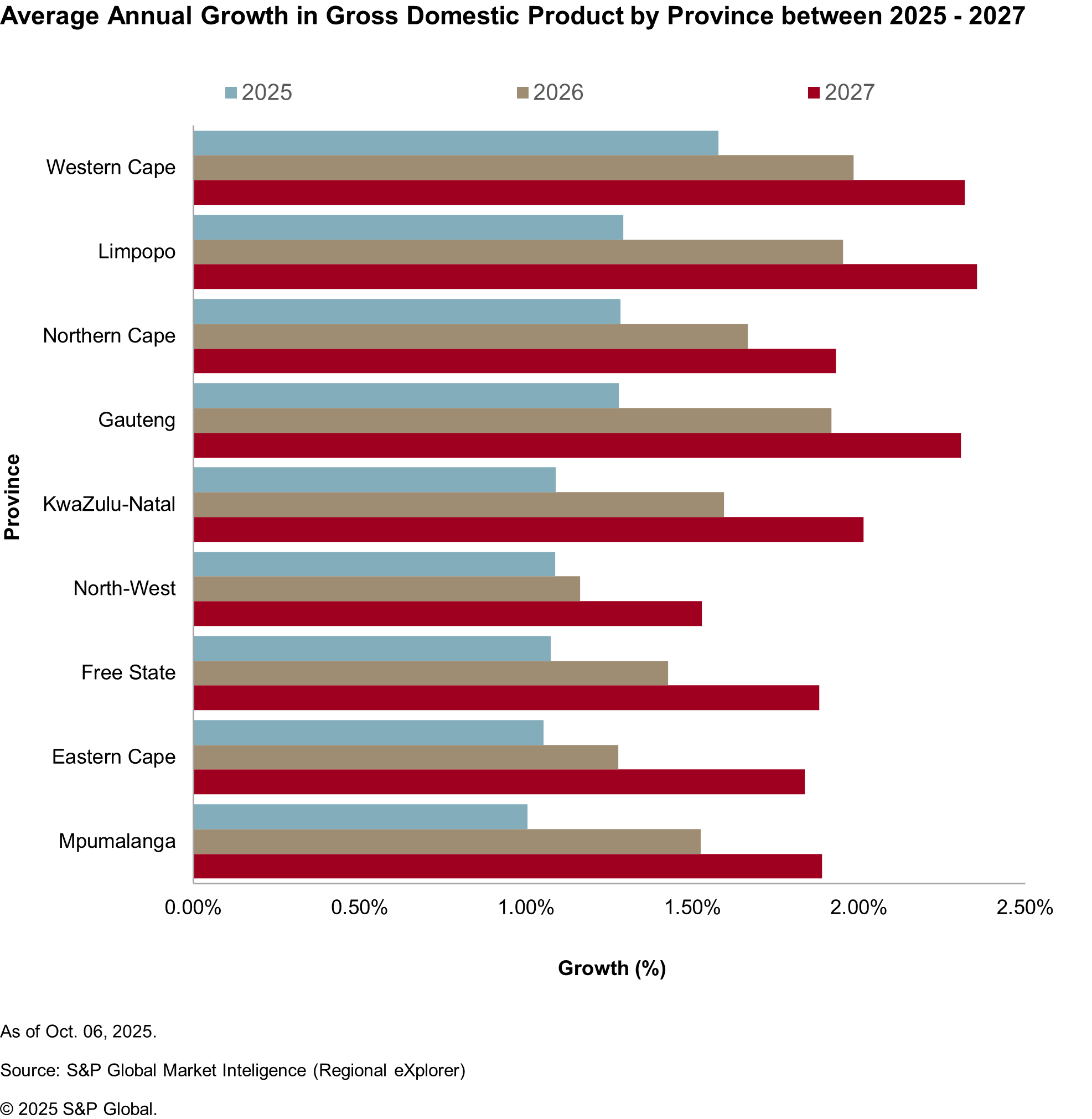 .
.
In addition, provincial GDP estimates from 2022 until 2024 have been revised following Stats SA’s re-release of provincial GDP data. The latest GDP forecasts from ReX for 2025-2027 follows these trends and can be seen in the following chart:
On par with S&P Global Market Intelligence Analysts forecast for South African GDP (see above), similarly the Provincial GDP forecasts are seeing a steady increase. With Gauteng, Western Cape and Limpopo trending towards a 2.5% average annual growth in GDP for 2027. Furthermore, Mpumalanga, North West and Free State’s growth rate increases significantly between 2025 and 2027. This is a positive outlook for South African regions that have mostly had a stagnant growth in GDP over the last few years.
The planned demographic data update has been postponed. Midway through the quarter, Stats SA released the second phase of the Census 2022 raw data. To ensure consistency, the update will be incorporated alongside the 2025 Mid-year Population Estimates (MYPE) in the next release.
What to Expect
The 2025 Q4 release, planned for mid-December, will feature a major update to the Demographic module as both the 2025 MYPE and the new Census 2022 Phase 2 results are integrated. Additionally, the Poverty Report, based on the Income and Expenditure Survey (IES) 2020, is expected to be released soon. Once available, these results will be incorporated into the model, leading to updates in all poverty-related variables.
Enjoy the update!
The S&P Global ReX team